One of the techniques frequently considered in modern hair restoration is DHI hair transplantation. DHI stands for Direct Hair Implantation and is an implantation technique designed to provide precise placement of individual hair follicles.
In this article, we explain what DHI hair transplantation is, how the procedure works, its potential benefits, recovery process and who may be a suitable candidate.
What Is DHI Hair Transplantation?
DHI, or Direct Hair Implantation, is a hair transplantation technique in which individual follicular units are extracted from a donor area and implanted into the recipient area using a specialized implantation device.
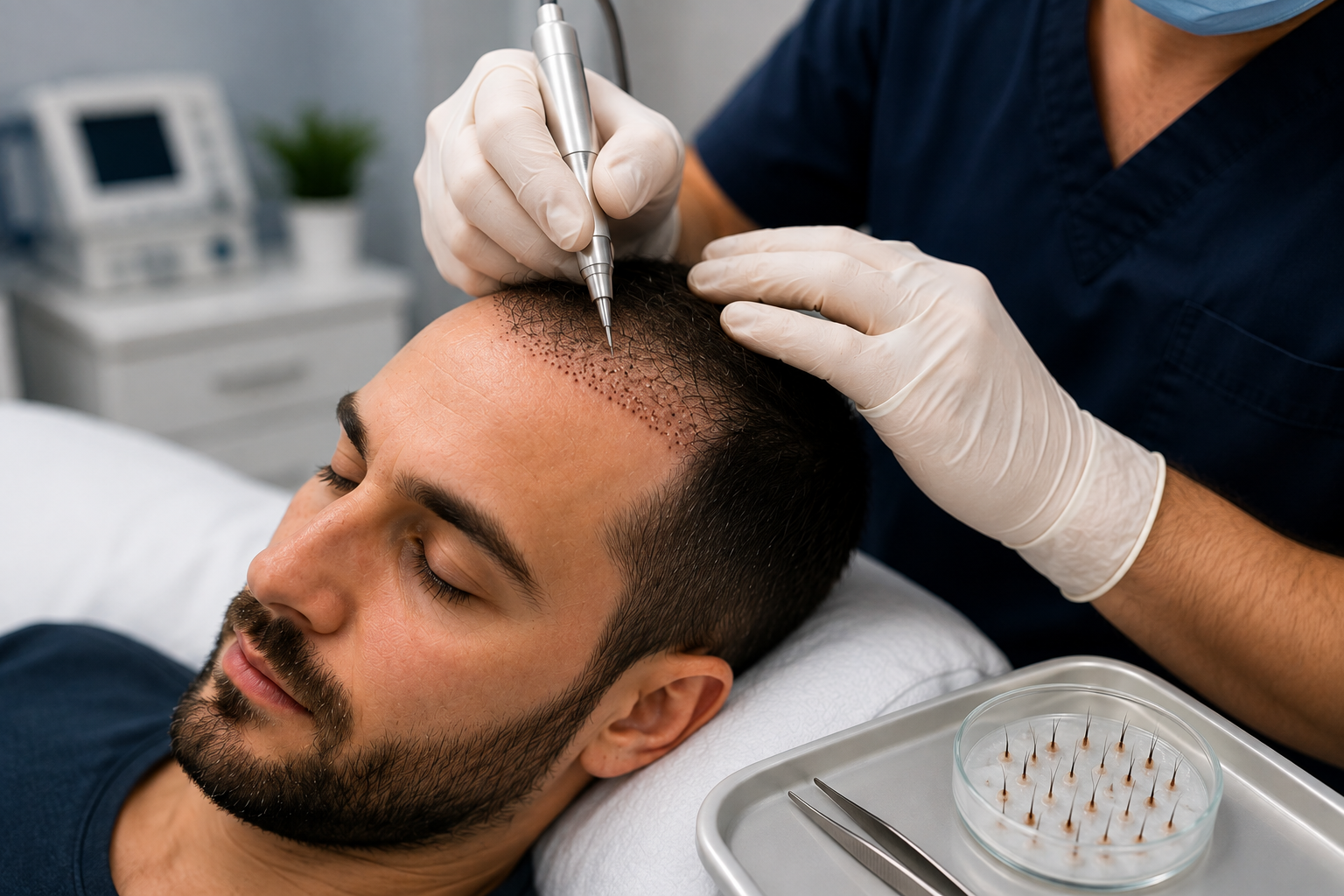
The device, commonly known as a Choi implanter pen, allows the medical professional to control the placement, angle and direction of the graft during implantation.
Unlike traditional strip harvesting, DHI does not involve removing a strip of scalp.
It is important to understand that DHI is primarily an implantation method. The extraction of follicles can still involve techniques such as FUE.
How Does DHI Hair Transplantation Work?
A DHI procedure generally consists of several carefully planned stages.
1. Consultation and Assessment
Before the procedure, the specialist evaluates the patient's hair loss pattern, donor area, scalp condition and overall suitability.
The patient's hairline and treatment areas are also assessed.
Factors such as age, existing hair density, donor supply and potential future hair loss should be considered when creating the treatment plan.
2. Hairline Design
The hairline is carefully designed according to the patient's facial proportions and natural hair characteristics.
A natural hairline should not appear artificially straight or excessively dense. Subtle variations in direction and density help create a more natural appearance.
3. Donor Area Preparation
The donor area is prepared before follicular extraction.
Local anesthesia is generally used to keep the patient comfortable throughout the procedure.
4. Follicular Unit Extraction
Individual follicular units are carefully extracted from the donor area.
The follicles are handled with care to protect their structure and maximize their potential for successful growth after implantation.
5. Graft Loading
The extracted follicles are carefully placed into the specialized implantation pen.
This allows the graft to be positioned directly into the recipient area during the implantation stage.
6. Direct Implantation
The implanter pen is used to place the grafts into the scalp.
The specialist controls the direction, angle and depth of placement according to the patient's existing hair pattern.
This level of control is particularly important around the frontal hairline, where the direction and angle of the follicles can strongly influence the final appearance.
What Are the Potential Benefits of DHI?
DHI can offer several potential advantages when appropriately performed.
Precise Graft Placement
The implantation pen allows the specialist to control the placement and direction of individual grafts.
This can be particularly useful when creating or refining the frontal hairline.
Natural-Looking Results
Careful control of graft direction and angle can help transplanted follicles blend with existing hair.
The final appearance depends on many factors, including donor hair quality, graft survival, hair characteristics and the skill of the medical team.
No Linear Scalp Scar
DHI does not require the removal of a strip of scalp.
Because individual follicles are extracted, there is no traditional linear scar associated with strip harvesting.
Individualized Treatment
The number and distribution of grafts can be planned according to the patient's specific needs.
This allows treatment to be tailored to different areas of hair loss.
Is DHI the Same as FUE?
DHI and FUE are often compared, but they are not exactly the same thing.
FUE describes a method of extracting individual follicular units from the donor area.
DHI primarily describes an implantation technique using a specialized implanter device.
In many cases, follicles can be extracted using an FUE approach and then implanted using a DHI technique.
Therefore, comparing FUE and DHI as completely separate procedures can sometimes be misleading.
The most appropriate approach depends on the patient's individual characteristics and treatment objectives.
Is DHI Hair Transplant Painful?
DHI is generally performed under local anesthesia.
The purpose of local anesthesia is to minimize discomfort during the procedure.
Patients may experience some pressure or sensation during different stages, while mild tenderness, redness or sensitivity may occur after treatment.
The individual experience varies, and the medical team should provide appropriate instructions for managing the recovery period.
How Long Does a DHI Procedure Take?
The duration depends mainly on the number of grafts being transplanted and the complexity of the treatment.
A smaller procedure may take less time, while larger sessions can require considerably longer.
The priority should be careful extraction, graft handling and implantation rather than completing the procedure as quickly as possible.
What Is the Recovery Like After DHI?
Recovery is generally gradual.
During the first days, patients may experience:
Mild redness
Small scabs
Temporary swelling
Scalp sensitivity
Mild discomfort
These effects usually improve as the scalp heals.
Patients should carefully follow the aftercare instructions provided by their medical team, including guidance about washing the scalp, sleeping position, exercise and avoiding unnecessary friction or pressure.
When Does Hair Start Growing After DHI?
Hair growth takes time.
The transplanted hairs may initially shed during the early stages after the procedure. This temporary shedding can be part of the normal hair growth cycle and is often referred to as shock loss.
New hair growth may become noticeable after several months.
The rate of growth varies between individuals, and the final result may take many months to develop.
Is DHI Hair Transplant Permanent?
Hair transplanted from suitable donor areas can provide long-lasting growth.
However, DHI does not necessarily prevent existing non-transplanted hair from continuing to thin.
For this reason, long-term planning is important. A specialist should consider both current hair loss and possible future progression before designing the treatment.
Who May Be Suitable for DHI?
DHI may be considered for patients experiencing certain types of permanent hair loss who have sufficient donor follicles.
A professional assessment may consider:
The cause of hair loss
Donor area density
Hair thickness and characteristics
The size of the recipient area
Scalp condition
Age and hair loss progression
Previous hair restoration procedures
Medical history
Treatment expectations
Not every patient is suitable for DHI, and an individual consultation is necessary before deciding on treatment.
Is DHI Suitable for Women?
DHI may be an option for some women experiencing suitable patterns of hair loss.
However, female hair loss can have many different causes. Identifying the underlying cause is therefore particularly important before considering transplantation.
A specialist should evaluate the patient's donor area, hair loss pattern and overall suitability.
What Should You Expect From DHI Results?
Patients should have realistic expectations.
The goal of hair transplantation is generally to improve coverage and create a natural-looking appearance rather than necessarily restoring the exact density someone had earlier in life.
The final outcome can be influenced by:
Donor hair quality
Number of available grafts
Hair thickness
Hair loss pattern
Graft survival
Implantation technique
Healing process
Individual hair growth
Future progression of hair loss
No responsible clinic should guarantee an identical result for every patient.
Frequently Asked Questions About DHI Hair Transplant
Is DHI better than FUE?
Neither technique is automatically better for every patient. DHI refers primarily to the implantation method, while FUE describes follicular extraction. The appropriate approach depends on individual characteristics.
Does DHI leave a scar?
DHI does not involve removing a strip of scalp, so it does not create the traditional linear scar associated with strip surgery. Individual extraction points may still be visible temporarily during healing.
How long does DHI hair transplantation take?
The duration depends on the number of grafts and the complexity of the procedure. Each treatment plan is different.
When can I return to normal activities?
Recovery varies between individuals. Your medical team should provide personalized instructions regarding work, exercise, washing and other activities.
Can DHI restore a receding hairline?
DHI can be considered for suitable patients with a receding hairline. Careful hairline design and graft placement are particularly important in this area.
Final Thoughts
DHI hair transplantation is a modern implantation technique that allows individual follicular units to be placed precisely into areas affected by hair loss.
Its success depends on appropriate patient selection, careful donor management, natural hairline design, precise graft placement and proper aftercare.
If you are considering DHI, a professional consultation can help determine whether this approach is suitable for your hair loss pattern and what type of result can realistically be expected.
Important: Hair transplantation is a medical procedure. This article is intended for general educational purposes and does not replace an individual medical evaluation or professional medical advice.