
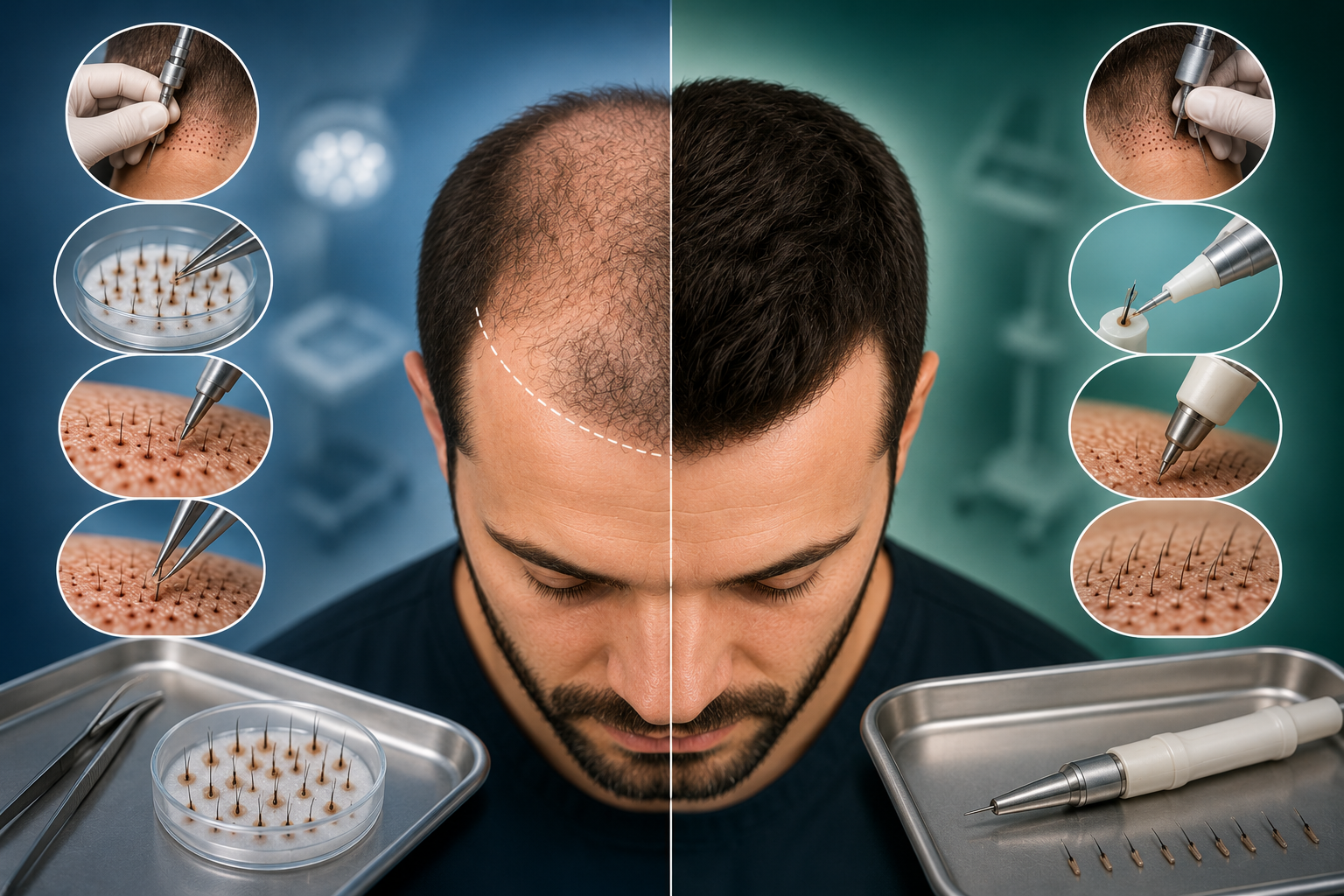
Both approaches are used to restore hair by transplanting individual follicular units from a donor area to areas affected by hair loss. However, the main difference lies in how the follicles are implanted and how the procedure is performed.
Understanding the differences between FUE and DHI can help you have a more informed discussion with a hair transplant specialist.
What Is FUE Hair Transplantation?
FUE stands for Follicular Unit Extraction.
With FUE, individual hair follicles are carefully extracted from the donor area, usually from the back or sides of the scalp. The extracted grafts are then prepared and implanted into the recipient area.
The procedure generally involves:
Planning the treatment and hairline
Preparing the donor area
Extracting individual follicular units
Preparing the grafts
Creating recipient sites
Implanting the grafts
The direction, angle and density of implantation are carefully planned to achieve a natural-looking result.
What Is DHI Hair Transplantation?
DHI stands for Direct Hair Implantation.
DHI is primarily an implantation technique. Individual follicular units are extracted from the donor area and then implanted using a specialized implanter device, commonly known as a Choi pen.
The implanter allows the specialist to control the placement, angle and direction of the graft during implantation.
A DHI procedure may therefore use an FUE-type extraction method followed by direct implantation with an implanter pen.
The Main Difference Between FUE and DHI
The biggest difference is the implantation process.
In a traditional FUE procedure, recipient sites are generally prepared before the grafts are implanted.
With DHI, the graft can be loaded into an implanter device and placed directly into the scalp.
This distinction can provide the medical team with different options for controlling graft placement depending on the patient's needs.
FUE vs. DHI: Comparison
| Feature | FUE | DHI |
|---|---|---|
| Follicle extraction | Individual extraction | Individual extraction |
| Implantation | Recipient sites are created before graft placement | Specialized implanter used for placement |
| Hairline design | Yes | Yes |
| Linear scar | No traditional linear scar | No traditional linear scar |
| Graft placement control | High | High |
| Suitable treatment areas | Hairline, crown and thinning areas | Hairline and selected thinning areas |
| Procedure | Individualized | Individualized |
| Recovery | Varies by patient | Varies by patient |
The exact procedure may vary depending on the clinic, medical team and individual treatment plan.
Which Technique Is Better?
There is no single technique that is automatically better for every patient.
A common mistake is to choose a hair transplant method based only on the name of the technique.
The most appropriate approach depends on factors such as:
The extent of hair loss
Donor area density
Hair thickness
Hair characteristics
Scalp condition
Size of the recipient area
Existing hair density
Hairline design
Future hair loss
Patient expectations
A specialist should evaluate these factors before recommending a treatment approach.
FUE for Larger Treatment Areas
FUE can be a practical option when a relatively large area needs to be treated.
Because individual grafts are extracted and prepared before implantation, the technique can be adapted to different levels of hair loss.
It may be considered for areas such as:
Receding hairlines
Frontal scalp
Mid-scalp
Crown
Larger thinning areas
The number of available donor follicles remains an important limitation regardless of the technique used.
DHI for Precise Implantation
DHI uses a specialized implanter device that allows the graft to be placed directly into the recipient area.
This can provide precise control over the angle and direction of individual grafts.
Such control can be particularly useful when working around the frontal hairline, where the direction of the transplanted follicles plays an important role in creating a natural appearance.
Is DHI Less Invasive Than FUE?
It is important not to describe DHI and FUE simply as completely different levels of invasiveness.
FUE refers primarily to how follicles are extracted, while DHI refers primarily to how follicles are implanted.
Both approaches involve extracting and transplanting individual hair follicles.
The overall invasiveness and recovery experience can depend on the number of grafts, treatment area, technique used and individual healing response.
Which One Has a Faster Recovery?
Recovery varies from patient to patient.
Both FUE and DHI involve small treatment sites, and patients may experience temporary redness, swelling, sensitivity or scabbing.
The number of grafts transplanted and the size of the treatment area can influence the recovery period.
Following post-operative instructions is an important part of the healing process regardless of the technique.
Do FUE and DHI Produce Natural Results?
Both techniques can produce natural-looking results when appropriately planned and performed.
Natural appearance depends on more than the name of the procedure.
Important factors include:
Hairline design
Graft distribution
Hair direction
Implantation angle
Donor hair quality
Graft handling
Existing hair density
Long-term treatment planning
The goal should be to create a result that blends naturally with the patient's existing hair.
Can Both Techniques Be Used for Women?
Both FUE and DHI may be considered for suitable female patients.
However, the cause of hair loss should be evaluated carefully.
Women can experience hair loss for many different reasons, and transplantation may not be appropriate in every situation.
A professional assessment can determine whether sufficient donor hair is available and whether transplantation is a suitable option.
What About Hairline Restoration?
Both FUE and DHI can be used for hairline restoration.
The frontal hairline requires particularly careful planning because it is one of the most visible parts of the result.
A natural hairline should take into account:
Facial proportions
Age
Existing hair
Hair direction
Hair thickness
Future hair loss
Creating an excessively low or perfectly straight hairline may not provide a natural long-term appearance.
What About Crown Hair Transplantation?
Both approaches can also be used in suitable cases involving crown thinning.
However, the crown has a distinctive circular growth pattern, which makes graft direction and placement especially important.
The available donor supply must also be considered when deciding how much density can realistically be achieved.
Which Technique Is Right for You?
The answer depends on your individual situation.
Instead of selecting FUE or DHI based on advertising claims, a professional evaluation should determine which approach is most appropriate.
During a consultation, the specialist may assess:
Your current hair loss
Donor area quality
Hair thickness
Scalp condition
Hairline
Future hair loss potential
Previous treatments
Desired result
A personalized treatment plan can then be developed.
Frequently Asked Questions
Is DHI more expensive than FUE?
The cost can vary depending on the clinic, number of grafts, treatment complexity and services included. The technique alone does not determine the total cost.
Does FUE leave a visible scar?
FUE does not normally create the traditional linear scar associated with strip surgery. Individual extraction points may be temporarily visible during healing.
Does DHI guarantee better results?
No hair transplant technique can guarantee a specific result. Outcomes depend on individual factors, treatment planning, graft quality, surgical technique and healing.
Can FUE and DHI be combined?
In some treatment plans, follicles may be extracted using an FUE approach and then implanted using a DHI-style implanter technique. The appropriate method depends on the patient's needs.
Which technique is best for the hairline?
Both can be used for hairline restoration. The most important factors are appropriate design, graft placement, angle, direction and long-term planning.
Final Thoughts
FUE and DHI are modern approaches to hair transplantation, but they should not be viewed simply as competing procedures.
FUE primarily describes follicular extraction, while DHI primarily describes direct implantation using a specialized device.
The right approach depends on the patient's hair loss pattern, donor area, hair characteristics, treatment goals and long-term expectations.
If you are considering a hair transplant, a professional consultation is the best way to determine which technique and treatment plan may be most suitable for you.
Important: Hair transplantation is a medical procedure. This article is provided for general educational purposes and does not replace an individual medical evaluation or professional medical advice.