
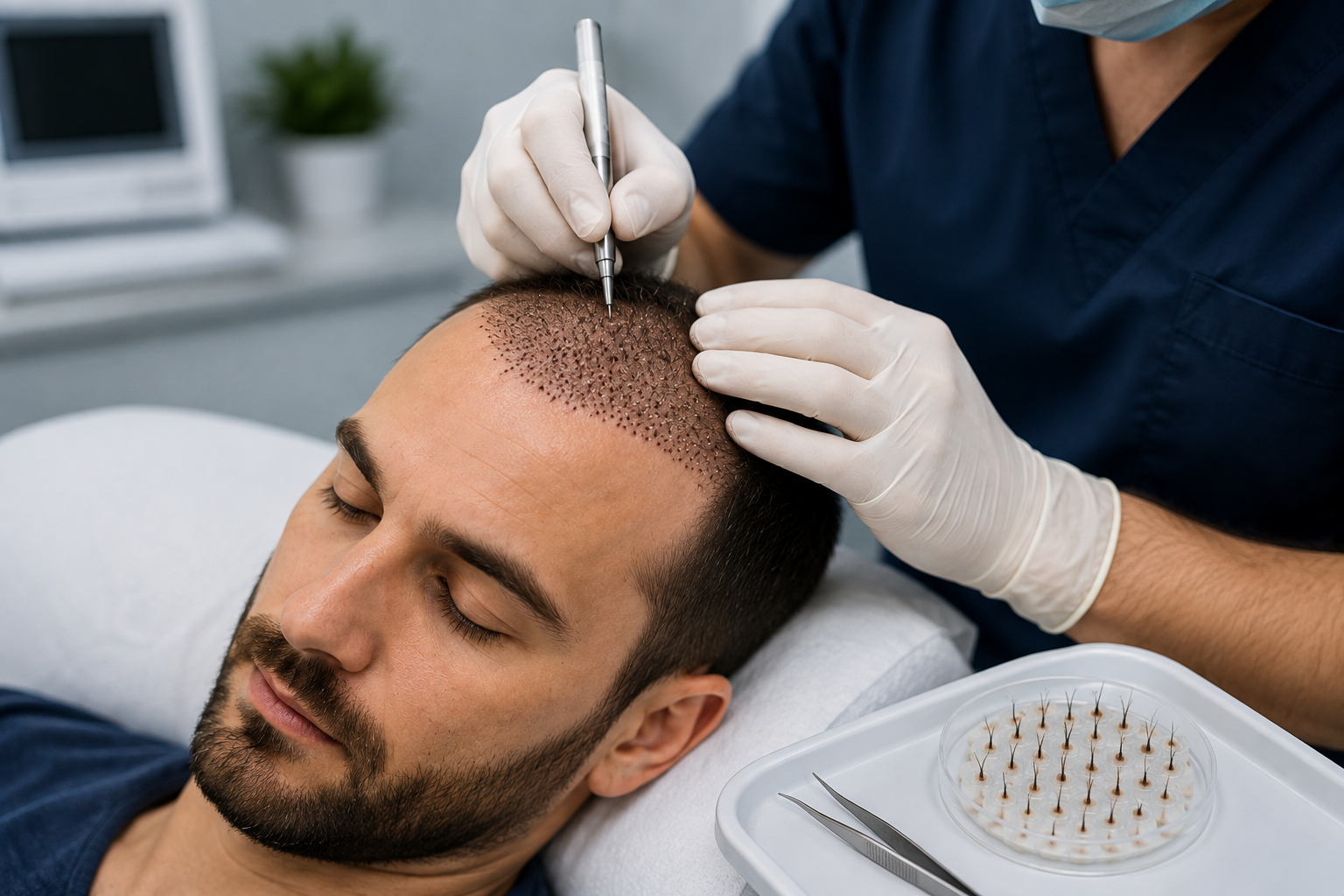
What Is FUE Hair Transplantation?
FUE stands for Follicular Unit Extraction.
During an FUE hair transplant, individual follicular units are carefully extracted from the donor area, usually located at the back or sides of the scalp. These follicles are then prepared and implanted into the recipient areas where hair density has decreased.
The procedure requires careful planning because the direction, angle and distribution of each graft can affect the final appearance.
The goal is not simply to add hair but to create a natural transition between the existing hair and transplanted follicles.
How Is an FUE Hair Transplant Performed?
Although the exact process can vary between patients, an FUE procedure generally involves several stages.
1. Consultation and Hairline Design
Before the procedure, the specialist evaluates the patient's hair loss, donor area and overall scalp condition.
The hairline is then carefully planned according to factors such as:
Facial proportions
Age
Existing hair
Hair loss pattern
Donor hair availability
Expected future hair loss
A well-designed hairline should look natural rather than artificially straight.
2. Preparation of the Donor Area
The donor area is prepared before follicular extraction.
Local anesthesia is generally used so that the patient remains comfortable during the procedure.
3. Individual Follicle Extraction
Using a specialized punch instrument, individual follicular units are extracted from the donor area.
The extraction process requires precision because excessive or poorly distributed extraction can affect the appearance of the donor area.
4. Graft Preparation
The extracted follicular units are carefully examined and prepared for implantation.
Depending on the characteristics of the patient's hair, grafts may contain one, two, three or more hairs.
Proper handling and preparation of the grafts are important throughout the procedure.
5. Recipient Area Preparation
Small recipient sites are created in the areas requiring additional coverage.
The direction and angle of these sites are carefully planned to follow the patient's natural hair growth pattern.
6. Graft Implantation
The prepared follicular units are placed into the recipient sites.
The specialist carefully considers the position and orientation of each graft to achieve a natural-looking distribution.
What Are the Benefits of FUE Hair Transplantation?
FUE has become popular because of several potential advantages.
No Traditional Linear Scar
Unlike strip-based hair transplantation, FUE does not normally involve removing a linear strip of scalp.
Instead, individual follicles are extracted separately, leaving small extraction points that generally become less noticeable as the area heals.
Natural-Looking Results
When the procedure is properly planned and performed, transplanted follicles can blend naturally with existing hair.
Hairline design and graft placement are particularly important for achieving a natural appearance.
Individualized Treatment
The number and placement of grafts can be planned according to the patient's specific hair loss pattern and available donor supply.
Suitable for Many Hair Loss Patterns
FUE may be considered for different patterns of hair loss, including receding hairlines, thinning areas and some cases of more advanced hair loss.
However, suitability depends on the individual patient.
Is FUE Painful?
FUE is generally performed under local anesthesia.
Patients may feel some pressure or movement during different stages of the procedure, but local anesthesia is used to minimize discomfort.
Some tenderness, tightness or sensitivity may occur after the procedure. The intensity and duration of these sensations vary between individuals.
The medical team should provide appropriate instructions for managing the recovery period.
How Long Does an FUE Hair Transplant Take?
The duration depends on several factors, particularly the number of grafts being transplanted.
Smaller procedures may take less time, while larger sessions can require considerably longer.
The condition of the donor area, the size of the recipient area and the treatment plan can all affect the duration.
Rather than focusing only on speed, the priority should be careful graft extraction, handling and placement.
What Is the Recovery Like After FUE?
Recovery is gradual.
During the first days, patients may experience redness, swelling or small scabs in the treated areas.
Following the clinic's aftercare instructions is important during this period. Patients may be advised to avoid activities that could place unnecessary pressure or friction on the scalp.
The exact recovery instructions depend on the procedure and the patient's individual circumstances.
When Does Hair Start Growing After FUE?
Hair growth does not happen immediately after transplantation.
The transplanted hairs may initially shed as part of the normal hair growth cycle. This temporary shedding is commonly referred to as shock loss.
New growth may begin becoming noticeable after several months.
The progression varies from person to person, but hair transplant results generally develop gradually rather than appearing overnight.
Is FUE Hair Transplant Permanent?
Hair transplanted from suitable donor areas can provide long-lasting growth.
However, FUE does not necessarily prevent existing non-transplanted hair from continuing to thin.
This is why long-term treatment planning is important. A specialist should consider the patient's current hair loss as well as the possibility of future progression.
Who Is a Good Candidate for FUE?
FUE may be suitable for people with permanent hair loss who have sufficient healthy donor follicles.
A consultation should evaluate:
The cause of hair loss
Donor area density
Hair characteristics
Degree of hair loss
Scalp condition
Age and hair loss progression
Medical history
Treatment expectations
Not every patient is an appropriate candidate, and a professional assessment is necessary before treatment.
FUE vs. Other Hair Transplant Techniques
FUE is one of several approaches used in hair restoration.
Another commonly discussed technique is DHI, or Direct Hair Implantation. Although both approaches involve transferring individual follicular units, the implantation process and instruments used can differ.
The most appropriate technique depends on the patient's individual characteristics and treatment goals.
There is no single technique that is automatically best for every patient.
What Should You Expect From an FUE Hair Transplant?
Patients should have realistic expectations before undergoing treatment.
The objective is to improve hair coverage and create a natural appearance while using the available donor follicles responsibly.
The final result can be influenced by:
Donor hair quality
Number of available grafts
Hair thickness
Extent of hair loss
Surgical technique
Healing process
Natural hair growth characteristics
Future progression of hair loss
A professional consultation can help establish realistic expectations.
Frequently Asked Questions About FUE Hair Transplant
How many grafts are needed for an FUE transplant?
The number varies according to the size of the treatment area, degree of hair loss and donor hair availability. A personalized assessment is required.
Does FUE leave scars?
FUE creates small extraction points rather than a traditional linear scar. Their visibility can vary depending on healing, extraction technique and individual characteristics.
Can FUE be used for a receding hairline?
Yes. FUE may be used to restore or improve a receding hairline when the patient has an appropriate donor supply.
Can FUE be performed more than once?
Some patients may undergo additional procedures if more coverage is required or hair loss progresses. The donor area must be carefully assessed before another procedure.
When can I return to work after FUE?
The appropriate recovery period varies according to the individual and the type of work performed. Your medical team should provide personalized guidance.
Final Thoughts
FUE hair transplantation is a modern hair restoration technique that uses individual follicular units to improve areas affected by hair loss.
Its success depends on careful patient selection, appropriate donor management, natural hairline design, precise graft placement and proper aftercare.
If you are considering FUE, a professional consultation can help determine whether the technique is appropriate for your hair loss pattern and what type of result can realistically be expected.
Important: Hair transplantation is a medical procedure. This article is provided for general educational purposes and does not replace an individual medical evaluation or professional medical advice.