
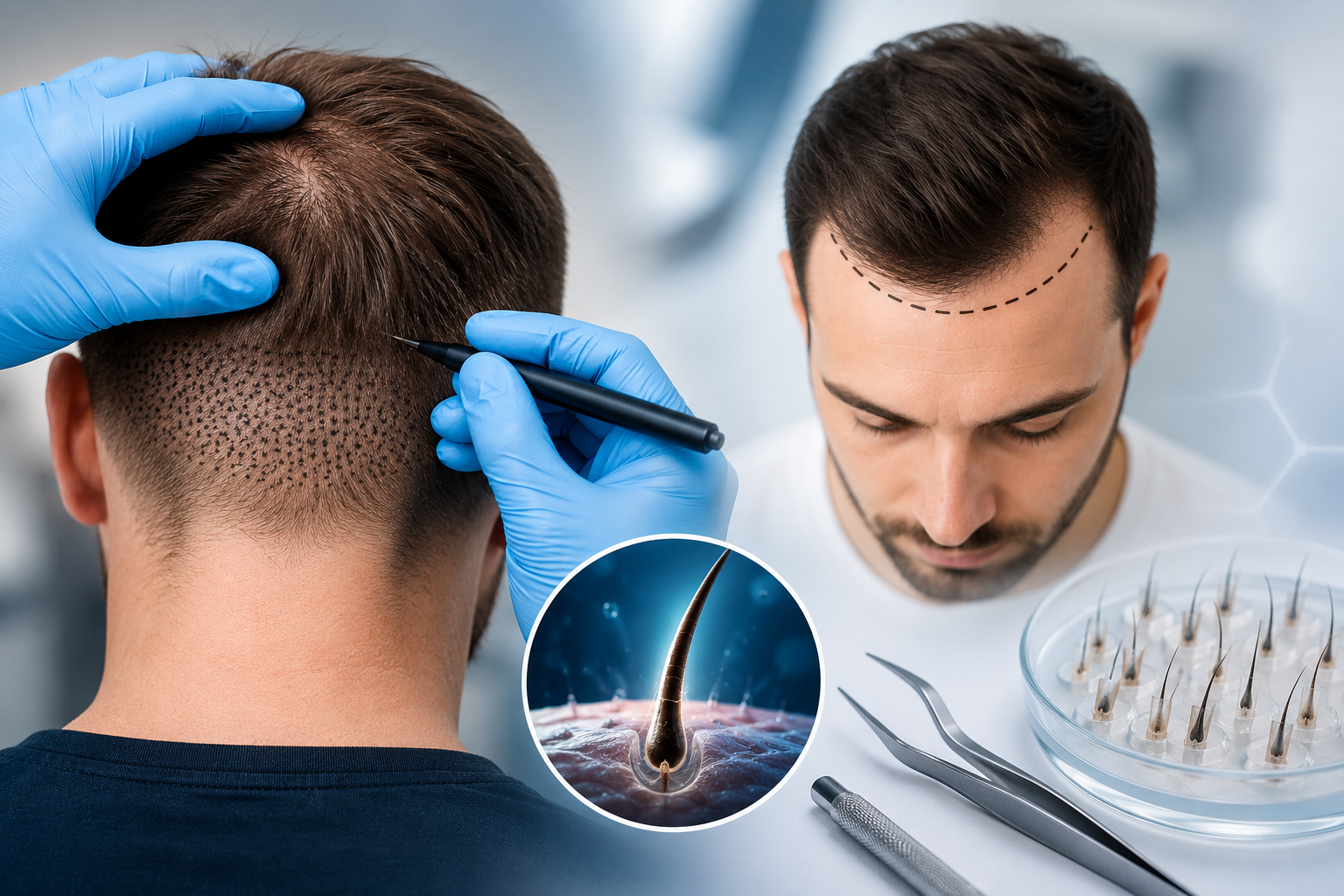
How Does a Hair Transplant Work?
A hair transplant involves several carefully planned stages. Before the procedure, a specialist evaluates the patient's hair loss pattern, donor area, scalp condition and expected future hair loss.
The donor area is usually located at the back or sides of the scalp because the hair follicles in these areas are generally more resistant to the effects of male pattern hair loss.
During the procedure, individual hair follicles or follicular units are carefully extracted from the donor area. These follicles are then prepared and transplanted into small channels or recipient sites created in the areas experiencing hair loss.
The direction, angle and density of the transplanted follicles are important for achieving a natural appearance. A well-planned hairline should complement the patient's facial features rather than simply placing as many grafts as possible.
What Are the Main Hair Transplant Techniques?
There are several techniques used in modern hair transplantation. Two of the most commonly discussed methods are FUE and DHI.
FUE Hair Transplant
FUE, or Follicular Unit Extraction, is a minimally invasive hair transplant technique in which individual follicular units are extracted from the donor area.
After extraction, the follicles are prepared and implanted into the recipient area.
One of the main advantages of FUE is that it does not normally require a linear incision. This means there is no traditional long surgical scar across the back of the scalp.
DHI Hair Transplant
DHI, or Direct Hair Implantation, is a technique in which extracted hair follicles are implanted using a specialized implantation device.
The technique allows the specialist to control the placement, angle and direction of the follicles during implantation.
Whether FUE or DHI is more appropriate depends on several factors, including the patient's hair loss pattern, donor area, hair characteristics and treatment goals.
Who Can Have a Hair Transplant?
A hair transplant may be suitable for people experiencing certain types of permanent hair loss, particularly androgenetic alopecia, commonly known as male or female pattern hair loss.
However, not everyone is an ideal candidate.
A proper consultation should evaluate:
The cause and pattern of hair loss
The quality and density of the donor area
The patient's age and hair loss progression
Existing medical conditions
Previous hair transplant procedures
The patient's expectations
The availability of sufficient donor follicles
In some cases, treating an underlying cause of hair loss may be recommended before considering transplantation.
Is a Hair Transplant Permanent?
Hair transplanted from areas that are resistant to pattern hair loss can provide long-lasting growth.
However, it is important to understand that a hair transplant does not necessarily stop future hair loss in untreated areas of the scalp.
For this reason, long-term planning is an important part of the treatment. A specialist should consider both the current pattern of hair loss and the possibility of future progression when designing the hairline and determining graft placement.
What Happens After a Hair Transplant?
The recovery process continues after the procedure.
It is normal to experience some redness, swelling, sensitivity or small scabs during the early recovery period. These effects generally improve as the scalp heals.
One of the most important stages is the period known as shock loss. Transplanted hairs may temporarily shed during the first weeks after the procedure. This can be concerning for patients, but temporary shedding can be part of the normal hair growth cycle following transplantation.
The follicles remain in place and new hair growth can gradually begin afterward.
Hair growth is a gradual process rather than an immediate transformation. Many patients begin noticing new growth during the following months, while the final result can take considerably longer to develop.
When Will the Results Become Visible?
Hair transplant results develop progressively.
A general timeline may look like this:
First weeks: The scalp begins healing and temporary shedding may occur.
Around 3–4 months: New hair growth may start becoming noticeable.
Around 5–6 months: Hair growth and coverage can become more apparent.
Around 9–12 months: A significant improvement may be visible.
12 months and beyond: The final appearance continues to mature, depending on the individual.
Every patient is different, so the exact timeline cannot be guaranteed.
Does a Hair Transplant Look Natural?
A properly planned hair transplant can produce a natural-looking appearance.
The design of the hairline is particularly important. A natural hairline is not perfectly straight. It contains subtle variations in density, direction and positioning.
The specialist must also consider the patient's age, facial proportions, existing hair and future hair loss.
The objective should not simply be to maximize the number of grafts. Instead, the goal should be to create an appropriate balance between density, natural appearance and long-term donor area management.
What Should You Consider Before Choosing a Hair Transplant Clinic?
Choosing the right clinic and medical team is an important decision.
Patients should consider the experience and qualifications of the medical professionals, the consultation process, the treatment plan and the clinic's approach to patient safety.
It is also important to be cautious about promises of guaranteed results. Hair transplantation is an individualized medical procedure, and results can vary from one person to another.
A professional consultation should provide realistic expectations based on the patient's individual characteristics.
Frequently Asked Questions About Hair Transplants
Is a hair transplant a surgical procedure?
Yes. Hair transplantation is a medical procedure and should be performed by appropriately qualified medical professionals in a suitable clinical environment.
How many grafts do I need?
The required number of grafts varies according to the extent of hair loss, donor area density, hair characteristics and treatment objectives. A personalized assessment is necessary to determine an appropriate graft number.
Can women have hair transplants?
Yes. Some women with suitable types of hair loss can be candidates for hair transplantation. The cause of hair loss should be evaluated before treatment.
Can transplanted hair fall out?
The transplanted hairs can temporarily shed during the early stages of recovery. The follicles can remain in the scalp and subsequently produce new hair growth.
When can I return to normal activities?
The recovery period varies from person to person and depends on the procedure performed. Your medical team should provide personalized instructions regarding work, exercise, washing and other activities.
Final Thoughts
A hair transplant can be an effective option for people experiencing permanent hair loss when the patient is appropriately selected and the procedure is carefully planned.
The success of the treatment depends on several factors, including donor hair quality, the extent of hair loss, surgical technique, hairline design, aftercare and the individual's natural hair growth characteristics.
If you are considering a hair transplant, a professional consultation is the best way to determine whether the procedure is appropriate for you and what type of treatment plan may provide the most natural and suitable result.
Important: Hair transplantation is a medical procedure. The information in this article is provided for general educational purposes and should not replace an individual medical consultation.